Your child reads — but maybe only the books with pictures, and maybe only when you ask.
Now picture them reaching for a book on their own. Arguing about a character over dinner. Copying a word they loved into a notebook, just because.
And you won’t have to nag. In a circle of friends who read, the pull comes from the other children — not from you. That is the whole design. We built this ourselves, ran it for a full season, and then listened hard to what the parents told us.
Reading is the original superpower
Every other subject is downstream of this one. History is reading. Science is reading. Even mathematics turns into reading the moment it gets interesting. A child who reads will find their way into almost anything; a child who doesn’t will find almost everything harder than it needed to be.
“If your child becomes a reader, about 80% of the education job is already done. That’s my honest assessment after working in education for over thirty years. Everything else is secondary.”
— Michael Strong, writing on X, February 2026We think that is close to right — and it is why we are not trying to teach your child fifteen things. We are trying to help them fall for one.
Not another app
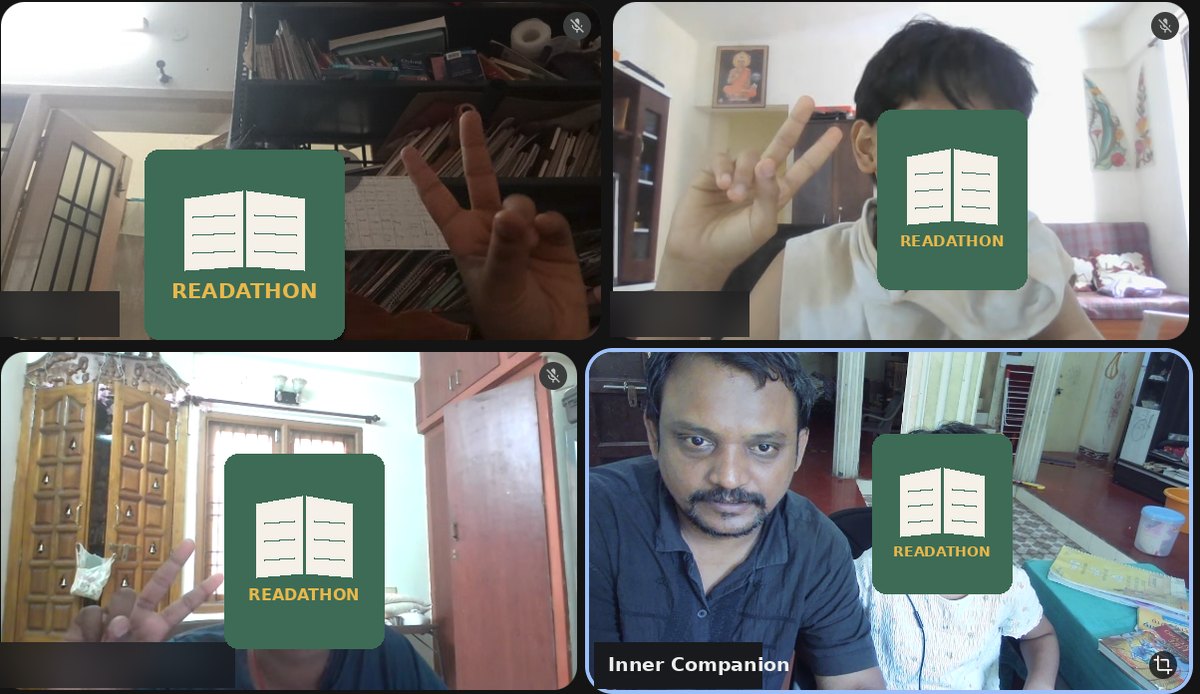
Your child has enough screens. Readathon Live is the opposite of a solo app or a video course — it is a real, live circle of children, together at the same hour, that sends them back to real books. No points. No badges. No algorithm. Just kids, a host their own age, and the oldest technology there is: a good story and someone to talk about it with.
“It is tough to find such an engaging circle in this digital world.”
— Arun · Parent · Season OneWe are deliberately swimming against a tide here. The Hindu put it well this July:
“Reading was once a conversation between a writer and a reader. Somewhere along the way, a committee of apps, trackers, challenges, badges, influencers, annual goals, and recommendation algorithms joined the discussion.”
— Chanchala Borah, ‘The reading race’, The Hindu, 26 July 2026We count nothing. We never ask how many pages, and we never post a tally. The only question that matters here is whether your child wanted to pick the book up again.
Play is how children fall in love with reading
We don’t tell children to read. We play — and the reading follows.
Every session is built on games: word ladders, spelling races, story-building, book-guessing, character charades. Play isn’t the warm-up before the “real” learning. Play is how the learning happens. It is what gets a shy child talking, what puts the confident and the hesitant on equal footing, and what turns a book from homework into something worth racing back to.
Because a child who is laughing about a book is a child who wants to read the next one. This is not a new idea — it is an old, unfashionable, thoroughly tested one. Play is how children have always been drawn into difficult things. We just refuse to be embarrassed about using it.
And once reading takes, it stops being ours to direct. They go after mythology, or football statistics, or a fat fantasy series we have never heard of. That is the superpower doing its own work.
If it helps to picture it: a bit of book club, a lot of play, some vocabulary building in disguise, and a small project to make and show. Not a syllabus. A way of being with books.
How a session actually works
Readathon Live is a two-hour block, and only the second hour is on a screen.
- The first hour — reading, at home. Your child reads on their own, in their own corner, in the hour before we meet. No call, no camera, no one watching. Whatever book they like, at whatever pace suits them.
- With one thing to look for. We send a small prompt ahead of each session — a word worth stealing, a character who changes their mind, a sentence they wish they had written. It gives the reading a direction without turning it into homework.
- The second hour — the circle. They arrive with the book still warm: a game, a book pitch, book talk, each Agent’s find from their notebook, and a small make-and-show that builds toward a showcase.
- Everyone leaves having recommended a book to another child — because the best reading list a kid ever gets comes from a kid they like.
Reading just before the circle is the whole trick. The book is fresh, they have something to say, and they walk in already switched on — so the hour builds on the children’s own energy instead of ours.
We run the reading hour on honour. We do not check pages or ask for logs. We are on WhatsApp through the week if a child gets stuck or a parent wants a nudge — but choosing the book and finding the time is theirs. That is the habit we are actually building.
Become a Literary Agent
Most children read passively — eyes slide over the words, and the words slide away. We turn them into Literary Agents: active readers on a mission, reading with a pencil in hand.
- A reading notebook — their Field Notebook — for the words, phrases and ideas they fall in love with. Any plain notebook you already have will do.
- Index cards — their Case Cards — one per book: a lesson, an inspiration, a writing idea, another book by the same author to chase next, the bits they’d tell a friend about.
And instead of “what did you learn today?”, the question is always “what did you find?” — because an Agent is an explorer, not a student. That one small shift changes how a child holds a book.
What we’re really after
Here is our promise, stated plainly. Take an emerging reader — a child who reads, but mostly picture books, mostly when asked — and in six months we want them reading chapter books on their own, by choice, and reading them like a Literary Agent. That is the outcome we are working toward, and the one you should hold us to.
Not a grade. Not a certificate. And not “bigger books” as a trophy.
The change we want is this: from being told what to read, to knowing what you want to read. A child who chooses their own books, follows their own curiosity, and can’t wait to get back to a story. Comics they devour, a series they race through, a chapter book they surprise you with — the freedom and the appetite are the point. Bigger, richer books tend to follow on their own.
- Choose books freely and reach for them without being asked.
- Read like an Agent — hunting words and ideas, not just turning pages.
- Talk about books with confidence — pitching, sharing, even disagreeing, out loud.
- Make something of their own and show it proudly to the circle.
- Belong to a small circle of friends who read.