Panjali Play
Bringing play to work. Bringing work to play.
She would be ready.
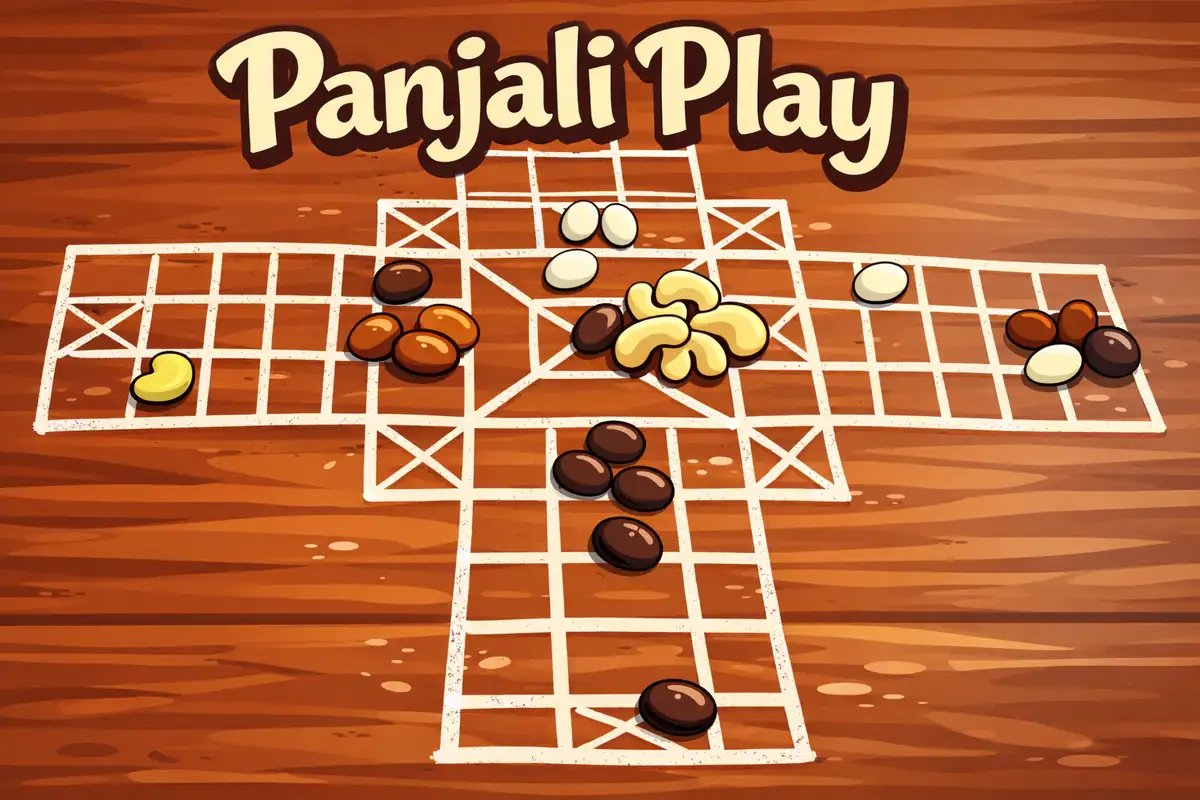
That’s what I remember most. Every day after school, I would run home — not walk, run — and Panjali, my grandmother, would already be there, waiting. Vibhuti bright on her forehead, the board drawn fresh on the floor in wet white chalk. Not too big, not too small. Just right. Drawn with care so it wouldn’t erase quickly.
The pieces were laid out: puliya kottai (tamarind seeds) and small jalli stones (smooth pebbles), each serving as coins and markers. She wouldn’t waste a single moment. Neither would we.
This was dhayam — an ancient Tamil board game played with four small stick-dice, where you race your pieces around a cross-shaped track, trying to bring them all safely home while your opponents hunt them down. My grandma / “paati” would team up with my younger brother against me. I would play alone against both of them. And somehow that felt fair — she was evening the odds, I think, the way grandmothers do, making sure both sides had a real chance. When my little brother threw a dhayam (the rarest, luckiest throw) or a panandu (twelve — another powerful move), she would light up like he had done something miraculous. Genuinely amazed at his luck. Delighted by it.
There was laughter. Gentle competition. A slight, quiet respect when someone won. And always the satisfaction of finishing the game to the full — so many twists and turns, pieces almost home and then killed, comebacks from nowhere. We played every game to the end.
What is play, exactly?
Before I go further, let me say what I mean — because play is one of those words people collapse into a single image. A child with a toy. A football match. Something you do when the real work is done.
That’s not what I mean.
Play, as I understand it from a life of doing it, is any activity where you are fully present, intrinsically motivated, and free — even briefly — from the pressure to perform or produce. It doesn’t require competition. It doesn’t require sport. It doesn’t require winning. It requires only that you are genuinely in it, not watching yourself from outside wondering how you look or what it will lead to.
Play is the state. The game is just one possible container for it.
After Paati was gone, I carried what she had seeded — without knowing it.
Childhood: Cricket in the lane, where I was the kind of player no one could get out easily. Carrom boards through summer afternoons. Seven stones — pitthu — where one team rebuilds a stack of stones while the other hunts them with a ball. Goli (marbles, shot across dust with a practiced thumb-flick). Raja Rani Chor Sipahi (King, Queen, Thief, Soldier — a card game of hidden identities and quick reading of faces). Bambaram — spinning tops — the art being how long you could keep yours alive while knocking out everyone else’s. Kabaddi, where the raider crosses into enemy territory on one breath, chanting “kabaddi kabaddi” while tagging opponents and racing back. Anju kallu — five stones — picking up stones in increasingly impossible patterns while keeping one in the air. Flying kites, which is its own kind of meditation — reading the wind, adjusting the string tension, feeling the sky through your fingertips. Improvised hand-tennis at a friend’s house, where a wall and two bare palms were all you needed. Trade in summer — all-day marathons the way only children can commit to something. Chess. Mario, which taught me more about persistence than most things.
I was alive when I was playing. That’s the only way I know how to say it.
Then came Class Ten.
My school was strict. Marks were everything. Somewhere in the pressure, a message arrived — not written anywhere, not spoken directly, but completely clear: it is time to grow up. Play is behind you now.
I know the exact feeling that preceded it. It was our Tamil teacher taking the PT period — our outdoor, free, physical period — to catch up on missed lessons. She was a good teacher, well-intentioned and passionate. I hold nothing against her. But when that period was cancelled, when we would not be going outside, something in me went very quiet. I was the saddest person in that school building on those days. Genuinely grumpy. A small grief I had no words for.
That, I now understand, is where it starts for most of us.
Not one dramatic moment. Just a slow series of reasonable-sounding decisions. PT can wait, the exam cannot. Play later, study now. Grow up first, enjoy later. And we agree, because everyone around us is agreeing, because it seems like the responsible thing to do. The days begin to feel like a series of checkboxes rather than a journey — and we call that maturity.
College: The games changed shape, but the instinct didn’t die. Cricket when I could. And something else was happening too — a different kind of play. With Jayashree, who would become my wife and co-founder, we ran projects entirely by choice: a survey on honest communication within families, a workshop called “Have Pride and Be Humble” for junior students, a quiz competition I redesigned from scratch to be genuinely interesting rather than a test of memory. None were required. All of them were play — we were making things we cared about, in forms we invented ourselves. Intellectual play, looking back. The same spirit, a different board.
Working life: In my twenties, in sales, the play found new containers. Foosball at the office. Snooker evenings. Indoor cricket, football five-a-side, late-night badminton in a friend’s backyard under improvised light. You find your games wherever you are. I always did — not consistently, not with the daily-ness of those afternoons with Paati, but the thread never fully broke.
Now: I am a father — a son who, without knowing it, is returning the favour my grandmother once did me. He brings play into rooms I had forgotten were available for it. A made-up game here. A ridiculous challenge there. The look on his face when something is genuinely fun — unburdened, fully in it — is both a mirror and a reminder.
The man watching him play is someone with more receding hairline than he started with, who has spent more years being productive than being present, who knows — finally, clearly — what has been missing.
I have played all these years. But not consistently. Not every day. Not with the depth and dailiness that Paati understood was simply how life should be. I have kept it at the edges rather than the centre. And I can feel the difference.
Here is what I have come to understand — slowly, and mostly by living it rather than reading it:
We are not just separated from play as we grow up. We become separated from a part of ourselves. The part that learns through doing rather than performing. The part that connects with others without agenda. The part that can be genuinely surprised, delighted, alive in a moment without wondering what it will produce.
This separation happens the same way my PT periods disappeared — one reasonable decision at a time. And over time, we stop noticing the absence because we are too busy with the things that replaced it.
Play is not the opposite of serious work. It is what makes serious work sustainable.
This is where the transformation begins. With me. And perhaps with you.
Not eight hours a day. Just whatever form is right for me — however small, however unconventional, however different from what play looked like when I was nine. Flying a kite. A card game after dinner. A walk without a podcast in my ears. A game with my son where I am actually playing and not supervising.
This is my reminder to myself: the board is already drawn. The pieces are laid out. All that remains is to be ready — the way Panjali Paati always was.
Each of us has something specific to offer the world — and it usually lives closest to the things we loved before anyone told us what was useful. Play is mine. It always was. Panjali Paati knew it before I did. She drew the board. She laid out the pieces. She was ready.
What would it mean for you to be ready?
What was the game that defined your childhood? When did you stop playing it — and what brought it back, even a little? I’d love to hear in the comments.
Arasu Gunasekaran is Co-Founder of Inner Companion Alternative Learning & Research Foundation. He writes about play, learning, and what it takes to build things that matter — without losing yourself in the process. innercompanion.in