Somewhere in my childhood, there is a banana leaf with water droplets on it. I must have been no older than seven or eight. I remember seeing it in the garden — those small, perfect spheres of water sitting on the broad green surface — and for a brief moment, something in me wanted to stop. To ask. To just sit there and watch.
But there was no time. My parents were already moving — the relentless morning choreography of working adults who had meals to prepare, buses to catch, and a day to survive before it had even properly begun. School was not much different. The water cycle was eventually explained to me in a classroom, with diagrams and labels and the correct vocabulary for each stage of evaporation and condensation. And I learned it. I repeated it. I passed the test.
But what I actually wanted — what some wordless part of me was reaching for at that banana leaf — was not an explanation. It was to witness. To sit with something alive and unfolding, and to let it land in my body before anyone translated it into language. Not to be a passerby, but to be consumed, even briefly, in the fullness and beauty of what was simply happening.
That, I have come to understand, is what deep knowledge actually is. And it is the thing that most of our learning never touches.
The Knowing That Is Already Here
There is a particular kind of urgency that drives modern learning. We build frameworks and theories. We design experiments to prove our assumptions. We measure outcomes and publish findings and cite each other in elaborate webs of mutual authority. There is value in all of this — but there is also, underneath it, a kind of restlessness, as though we believe that the truth is somewhere out there, just beyond the next study, the next credential, the next body of literature we have not yet consumed.
Deep knowledge begins from a different premise. It suggests that the most essential knowing is not something we acquire. It is something we uncover. That within each of us — beneath the conditioning, the noise, the performances we have rehearsed across decades of institutional learning — there is already a reservoir of truth. Not abstract truth. Personal truth. The kind that tells you, quietly and unmistakably, when something is right and when something is not. When a path is genuinely yours and when you are walking someone else’s.
This is not a mystical claim, though it can sound like one. It is simply the observation that the mind — which is not merely the brain, but includes the wisdom of the body, the gut, the ingrained sense of knowing that lives below language — is capable of discernment that no algorithm, no ranking system, and no external authority can replicate. We have simply been trained to distrust it.
All Paths Lead Inward
The destination of deep knowledge — if we can call it that — is the same for all of us, even when the paths look entirely different. Some arrive through physics. Some through farming. Some through raising children or sitting with the dying or learning to grow food from soil that does not easily yield. The jnana yogi arrives through philosophical inquiry; the farmer through the patient, embodied knowledge of seasons. Neither path is superior. What matters is whether the path you are walking is genuinely moving you toward knowing yourself — or whether it has become a more sophisticated form of looking away.
And this is where honesty is required. Because the colonial inheritance of our educational systems — built not to liberate but to produce compliant, efficient, measurable human beings — has left many of us with a deep and unexamined disconnection from our own inner authority. We were taught to look outward for validation, for truth, for the definition of what counts as knowledge at all. And so we learned to parrot scholars, to accumulate citations, to prove our intelligence through the volume and velocity of what we could recall and recite.
Deep knowledge asks us to pause before all of that, and to ask: what do I actually know, in my bones, to be true? Not what have I been told. Not what is currently fashionable or fundable or impressive at a conference. What do I know?
The Bud on the Dead Branch
There was a winter in New Hampshire that I will not forget. I was living with a particular weight — the kind that makes the world feel narrower than it is, and makes you wonder whether what appears depleted on the outside is, in fact, depleted all the way through. The trees outside the window had been bare for months. Lifeless, it seemed. Almost sculptural in their emptiness.
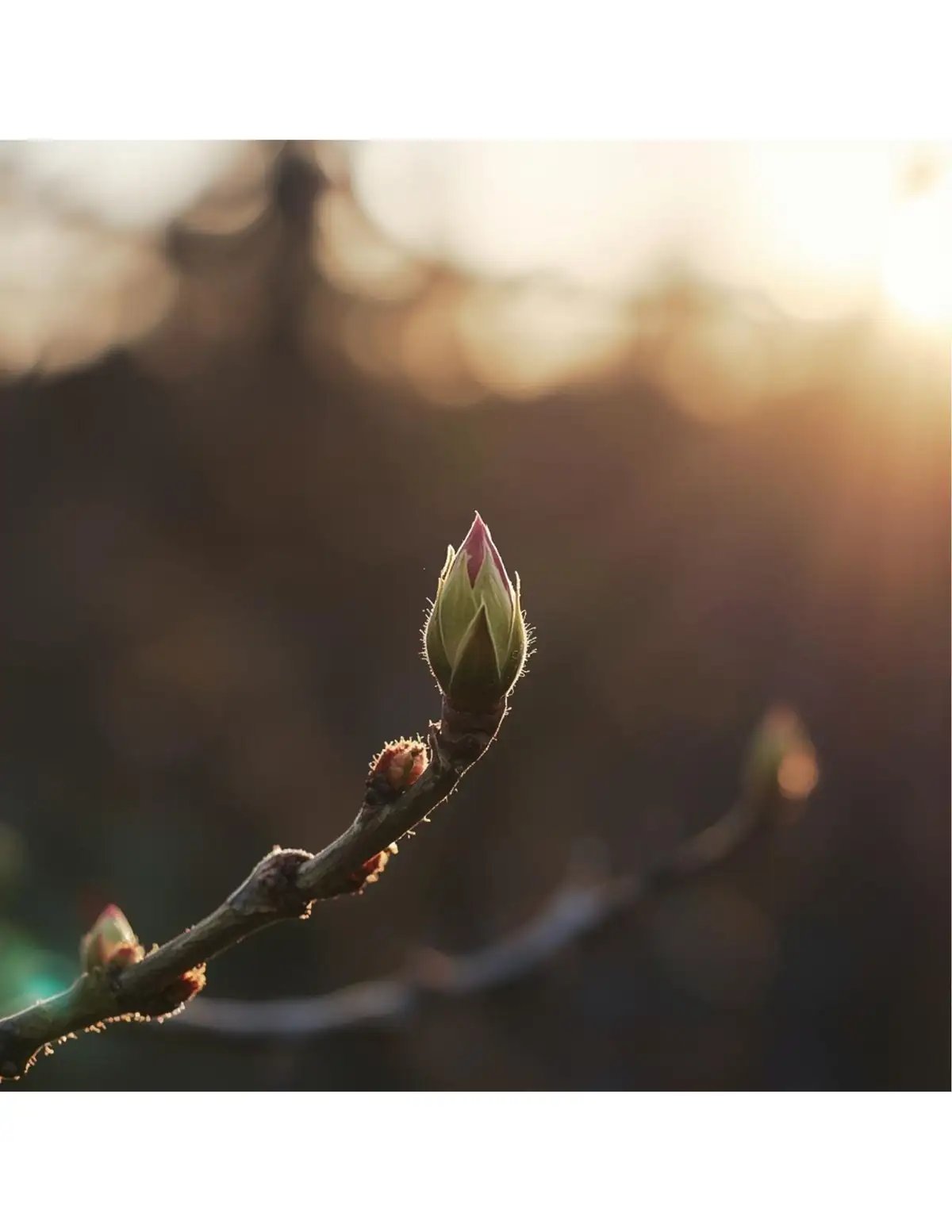
And then one morning — in what felt like a fleeting, almost accidental moment of attention — I saw a bud. Small and unremarkable to anyone passing by. But to me, in that moment, it was one of the most powerful things I had ever witnessed. Because what it said was this: life does not announce itself. It does not ask for permission or applause. It simply continues, quietly, in the dead branches. And when the conditions are right, it appears.
I was studying John Dewey at the time — education as experience, learning as a living process — and I remember discussing this with my mentor: the silent, potent life that the New Hampshire trees carried within themselves, and the parallel to what we all carry within us. The conversation was intellectual. But the knowing came from the window. It came from the bud.
This is the quality of deep knowledge that cannot be taught in a classroom or summarised in a framework. It arrives when we are finally still enough to receive it. And it leaves us changed in ways we cannot always articulate, but that we carry forward nonetheless.
The Rush That Is Costing Us Everything
Can you explain the beauty of a morning dew forming on a grassland in twenty seconds? Can you compress what it feels like to watch a season turn — the long dying of autumn, the apparent death of winter, the impossible return of spring — into an elevator pitch? We laugh at the absurdity of the question. And yet this is precisely what we are being asked to do, in every domain of our lives, with increasing insistence.
The attention economy has not simply shortened our content. It has shortened our capacity for the kind of slow, receptive, unhurried attention that deep knowledge requires. We are rewarded — genuinely, materially rewarded — for speed, for brevity, for the ability to make ourselves legible in the smallest possible window of someone else’s interest. The twenty-second pitch. The viral post. The hot take that travels faster than the question it pretends to answer.
And yet something in us knows — and this is precisely the kind of knowing we are speaking of — that we are being diminished by this. Not dramatically. Not all at once. But gradually, in the way that a person who is always rushing begins to lose the ability to notice what they are rushing past. The bird call. The quality of light at a particular hour. The feeling in the body that says: this is not right for me. Stop.
Deep knowledge asks us to slow down. Not as a lifestyle aspiration, but as an act of resistance. Slow enough to hear your own breath. Slow enough to notice what you actually feel, as distinct from what you have been trained to perform. Slow enough to ask: what am I rushing toward, and at what cost?
Two Humans in One Body
I will be honest with you, because this article demands it. I am writing about the importance of slowing down while watching the clock. I am writing about the courage to choose knowing over being known, while feeling the very real pressure of visibility, of income, of the children who need to be taken care of and the bills that arrive regardless of how spiritually aligned one’s newsletter is.
I am, in other words, two humans living in one body. The one who sat at the window in New Hampshire and felt the tree speak. And the one who has internalised, deeply and against her better knowing, that sharing is worth more than knowing — that unless the insight travels outward and earns recognition, it does not fully count.
I suspect you know this tension. The part of you that has glimpsed something true and whole — in a moment of stillness, in a conversation that cracked something open, in a season of difficulty that revealed more about your own strength than any achievement ever did. And the part of you that then immediately asks: but what do I do with this? How do I make it useful, legible, shareable, productive?
Deep knowledge does not resolve this tension. It holds it. It asks us to live inside the question rather than escape it through the nearest available answer. It asks us to trust that the knowing itself — even when it remains private, even when it never becomes a post or a pitch or a published insight — is doing something essential. That to sit with what is true, quietly and without audience, is not a waste of a life. It may, in fact, be the whole point of one.
When we can rest in that — even momentarily, even imperfectly — we are not just at peace with ourselves. We are, at last, at home in the knowledge that we have always already been.
A Short Conversation With Yourself
What is something you know to be true — in your body, your gut, your deep self — that you have never yet said out loud?
When did you last learn something not because it was useful, but because it was beautiful?
Is the path you are currently walking moving you toward yourself, or away from yourself?
What is asking to be witnessed right now — not explained, not solved, just witnessed?